
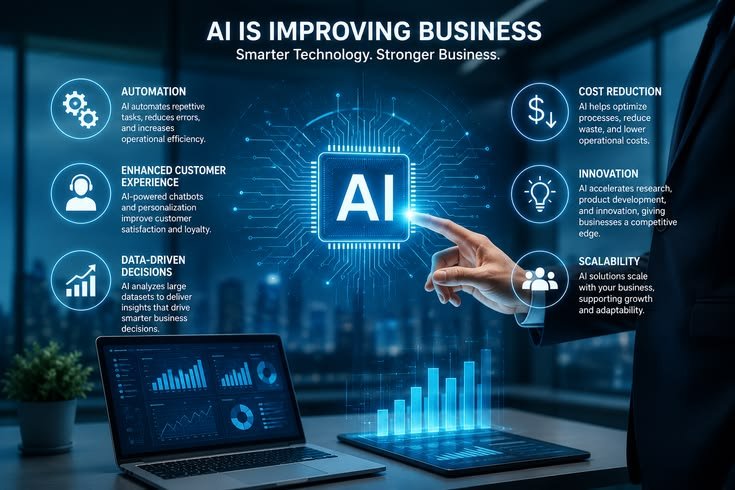
Artificial Intelligence is changing the way businesses manage daily operations, communicate with customers, analyze information, and complete repetitive tasks. From small businesses to large organizations, AI can help employees work more efficiently and spend more time on activities that require human judgment.
Business productivity is not simply about completing more tasks. It is about using time, resources, and employee skills effectively. AI can support this goal by handling repetitive work, organizing information, assisting with communication, analyzing data, and improving workflows.
However, businesses should not adopt AI simply because it is popular. The technology should be connected to clear business objectives and measurable results.
What Is AI Productivity?
AI productivity refers to using Artificial Intelligence tools to help employees and businesses complete tasks more efficiently.
AI can assist with activities such as:
- Writing and editing
- Email management
- Data analysis
- Customer support
- Research
- Meeting summaries
- Project management
- Marketing
- Sales
- Document processing
- Workflow automation
- Software development
The goal is usually to reduce repetitive work and help employees focus on higher-value responsibilities.
Why Businesses Are Using AI
Businesses deal with increasing amounts of information and communication every day.
Employees may spend hours reading emails, preparing documents, entering data, creating reports, attending meetings, and answering similar customer questions.
Many of these activities are necessary, but some are repetitive.
AI can assist with selected tasks and reduce the amount of manual effort required.
When implemented correctly, this can give employees more time to focus on strategy, creativity, customer relationships, problem-solving, and decision-making.
AI for Writing Business Content
Writing is an important part of almost every business.
Employees create emails, reports, proposals, product descriptions, website content, internal documents, presentations, and other materials.
AI writing tools can help generate initial drafts, rewrite existing text, summarize information, and adjust content for different audiences.
For example, a marketing employee could use AI to create an initial product description and then edit it according to the company’s brand guidelines.
This approach can be faster than starting from a blank page.
Human review is still important because AI-generated content can contain incorrect information or fail to match the company’s communication style.
AI for Email Management
Email can consume a significant amount of employee time.
AI can help summarize long email conversations, draft responses, identify important information, and organize messages.
For example, an employee returning from vacation could use an AI assistant to summarize a long email thread and identify outstanding tasks.
This can reduce the time required to manually review every message.
Important emails should always be reviewed before sending, especially when they involve customers, contracts, financial matters, or commitments.
AI Meeting Assistants
Meetings generate large amounts of information.
Employees may need to take notes, identify decisions, record action items, and distribute summaries afterward.
AI meeting assistants can help transcribe conversations, summarize discussions, and identify tasks.
This allows participants to focus more on the meeting itself rather than trying to record every detail.
Businesses should consider privacy requirements and internal policies when recording or processing meeting conversations.
AI for Research
Research is another area where AI can save time.
Employees may need to review reports, competitor information, industry publications, customer feedback, and other sources.
AI can help summarize large amounts of information and organize research findings.
For example, a marketing team could use AI to summarize customer feedback and identify common themes.
However, businesses should verify important facts against reliable sources before using them in decisions or public communications.
AI for Data Analysis
Businesses generate data from sales, customers, websites, operations, finance, and other areas.
Analyzing this information manually can take considerable time.
AI tools can help identify patterns, summarize datasets, generate formulas, and assist with data interpretation.
For example, a company could analyze sales data to identify changes in revenue or customer behavior.
AI can help employees understand data more quickly, but important business decisions should not rely on unverified AI conclusions.
AI for Customer Support
Customer support is an area where AI can provide significant productivity benefits.
Many customers ask similar questions about products, services, pricing, delivery, account management, or company policies.
AI chatbots can answer routine questions and provide information based on approved company resources.
More complex issues can be transferred to human support representatives.
This allows employees to spend more time on difficult customer problems instead of repeatedly answering basic questions.
AI for Sales Teams
Sales employees often spend time researching prospects, writing emails, updating customer records, and preparing sales materials.
AI can assist with these activities.
For example, AI can summarize previous customer interactions, create draft follow-up messages, organize prospect information, and help prepare sales documents.
Sales representatives can then spend more time talking with potential customers and building relationships.
AI-generated sales messages should be reviewed to ensure that they are accurate and appropriate.
AI for Marketing
Marketing teams manage many different activities, including content creation, research, campaign planning, customer analysis, and reporting.
AI can assist with brainstorming, content drafts, audience research, campaign analysis, and repetitive marketing tasks.
For example, marketers can use AI to generate multiple content ideas and then select the strongest concepts for further development.
AI can increase production speed, but human marketers still need to provide strategy, creativity, brand knowledge, and customer understanding.
AI for Project Management
Project management requires constant coordination.
Employees need to track deadlines, assign tasks, monitor progress, review documents, and communicate with team members.
AI-powered project management tools can help summarize project updates, identify overdue tasks, organize information, and generate task suggestions.
This can reduce administrative work for project managers.
However, AI should not independently determine important project priorities without human oversight.
AI for Document Management
Businesses often store large collections of documents.
Finding information in these files can take time.
AI document tools can help summarize files, extract important information, classify documents, and answer questions based on approved content.
This can be particularly useful for businesses with large amounts of internal documentation.
Access controls are important because employees should only be able to retrieve information they are authorized to see.
AI Workflow Automation
AI becomes particularly useful when combined with workflow automation.
Consider a process where a customer submits a form.
Normally, an employee might review the form, enter information into another system, send an email, and create a task.
Automation can connect these steps.
AI can add additional capabilities by analyzing incoming information and helping determine what action should happen next.
Businesses should start with simple workflows before automating complex processes.
AI for Human Resources
Human resources teams handle recruitment, employee communication, documentation, scheduling, and administrative work.
AI can assist with tasks such as drafting job descriptions, organizing applications, summarizing documents, and answering routine employee questions.
However, businesses should be careful when using AI in hiring or employee evaluation.
Important employment decisions should include appropriate human review because AI systems can introduce bias or make inappropriate recommendations.
AI for Finance and Accounting
Finance teams work with large amounts of numerical and transactional information.
AI can assist with data organization, document processing, expense categorization, reporting, and anomaly detection.
For example, AI can help identify transactions that appear unusual and require further review.
AI-generated financial information should be checked carefully.
Businesses should not rely on AI alone for important financial decisions, accounting judgments, or regulatory requirements.
AI for Software Development
Businesses that develop software can use AI coding assistants to improve developer productivity.
AI tools can generate code suggestions, explain programming concepts, identify potential errors, create documentation, and assist with testing.
Developers can use these tools to reduce repetitive coding tasks.
However, all generated code should be reviewed for security, correctness, performance, and compatibility.
AI for Internal Knowledge
Employees often waste time searching for information.
A company may have information spread across documents, emails, cloud storage, websites, and internal systems.
An AI-powered knowledge system can help employees search for information using natural language.
For example, an employee could ask about a company procedure and receive a summary based on approved internal documents.
This can reduce the time employees spend searching for information.
AI and Employee Training
AI can also support employee learning.
Businesses can use AI to create training materials, generate practice questions, explain complex concepts, and provide personalized learning assistance.
New employees can use AI-based internal systems to find information about company processes.
Training materials should still be reviewed by appropriate staff to ensure accuracy.
AI for Scheduling
Scheduling meetings and appointments can be repetitive.
AI scheduling systems can identify available times and help coordinate calendars.
This can reduce the number of messages employees need to exchange to arrange meetings.
For organizations with large teams, automated scheduling can save considerable administrative time.
How to Measure AI Productivity
Businesses should measure whether AI is actually improving productivity.
Useful metrics may include:
- Time saved per task
- Number of automated tasks
- Employee productivity
- Customer response time
- Error rates
- Operating costs
- Customer satisfaction
- Revenue generated
- Employee satisfaction
Without measurement, businesses may adopt AI tools without knowing whether they provide real value.
Start With Repetitive Tasks
Businesses should usually begin with repetitive, low-risk tasks.
For example, summarizing documents, organizing information, creating drafts, and answering routine questions can be good starting points.
Once employees understand the technology, the organization can consider more advanced applications.
Starting small also makes it easier to identify problems before AI becomes deeply integrated into business operations.
Protect Business Information
AI productivity tools may process company data, so businesses need to understand how information is handled.
Employees should know what information can be entered into external AI systems.
Sensitive customer data, passwords, confidential financial information, intellectual property, and proprietary business information may require additional protection.
Companies should establish clear AI usage policies.
Train Employees
Technology alone does not guarantee productivity.
Employees need to understand how to use AI effectively.
Training can cover:
- Writing clear prompts
- Checking AI-generated information
- Protecting confidential data
- Identifying AI limitations
- Using approved AI tools
- Reviewing automated outputs
Employees who understand both the benefits and limitations of AI are more likely to use it effectively.
Human Judgment Remains Important
AI can process information quickly, but it does not replace human responsibility.
Employees still need to make decisions, communicate with customers, understand business goals, and evaluate risks.
The strongest productivity strategies combine AI automation with human expertise.
AI should handle appropriate repetitive tasks while employees remain responsible for important decisions.
Common AI Productivity Mistakes
Businesses can make several mistakes when adopting AI.
One mistake is trying to automate everything immediately.
Another is selecting tools without defining a clear business problem.
Organizations may also ignore data privacy or fail to train employees.
Some businesses measure AI success only by the number of tasks automated instead of measuring actual business outcomes.
A better approach is to connect every AI project to a specific productivity goal.
Building an AI Productivity Culture
AI works best when employees understand that it is a productivity tool rather than a replacement for every human task.
Companies should encourage responsible experimentation while establishing clear boundaries.
Employees can share successful AI workflows and useful prompts with colleagues.
Over time, this can create a workplace culture where AI is used strategically.
Conclusion
Businesses can use AI to improve productivity across many areas, including writing, email management, meetings, research, data analysis, customer support, sales, marketing, project management, human resources, finance, software development, and workflow automation.
The biggest opportunity is often found in repetitive tasks that consume employee time without requiring significant human judgment.
However, successful AI adoption requires more than purchasing software. Businesses need clear goals, employee training, data protection, human oversight, and measurable performance indicators.
AI should support employees rather than remove human responsibility. When businesses combine AI capabilities with human expertise, they can reduce repetitive work, improve workflows, respond to customers more efficiently, and allow employees to focus on higher-value activities.
The future of business productivity will likely involve a combination of human creativity, professional judgment, automation, and AI-assisted decision support. Companies that approach AI strategically can use the technology to improve efficiency while maintaining quality, security, and responsible business practices.



Leave a Reply