

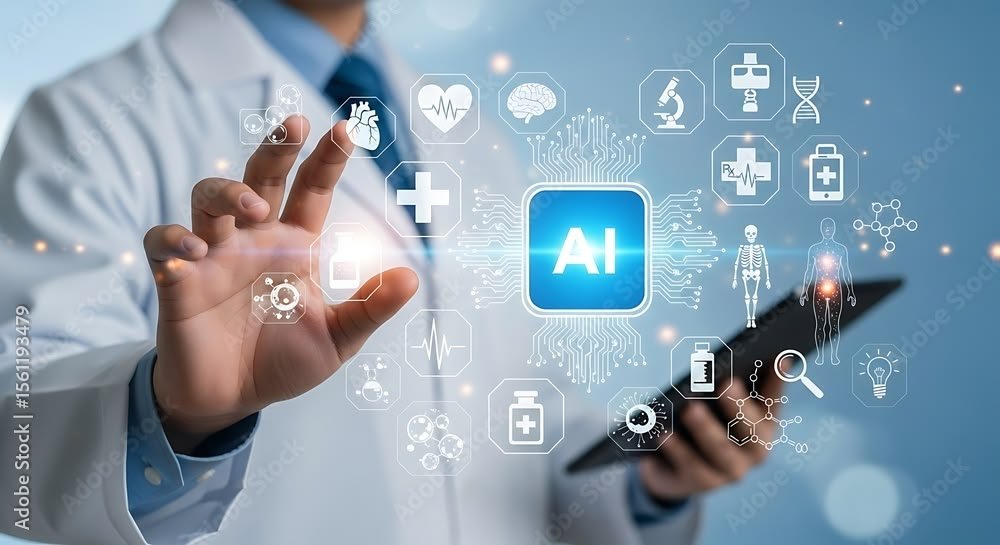
Artificial Intelligence is becoming an important technology in modern healthcare. AI systems can process large amounts of information, recognize patterns, automate repetitive tasks, support medical research, and assist healthcare professionals with selected activities.
The growth of AI in healthcare offers significant opportunities, but it also introduces challenges that need careful attention. Healthcare involves sensitive information and decisions that can have serious consequences, so AI systems must be developed and used responsibly.
Understanding both the benefits and challenges of AI in healthcare provides a more realistic view of what this technology can offer.
What Is AI in Healthcare?
AI in healthcare refers to the use of Artificial Intelligence technologies to support healthcare-related tasks.
These technologies include Machine Learning, Deep Learning, Natural Language Processing, and Computer Vision.
AI can be used to analyze medical images, summarize records, support research, process administrative information, assist with monitoring, and provide certain types of decision support.
The exact capabilities depend on the AI system and its intended use.
Why Healthcare Is Using AI
Healthcare organizations deal with large amounts of information every day.
Medical records, laboratory results, diagnostic images, research papers, prescriptions, appointment information, and monitoring data can be difficult to process manually.
AI can analyze certain types of information quickly and help identify patterns.
Healthcare organizations are also looking for ways to reduce administrative workloads and improve operational efficiency.
These factors have contributed to growing interest in AI-powered healthcare technology.
Benefits of AI in Healthcare
Faster Data Processing
One of the major advantages of AI is its ability to process large amounts of information quickly.
Healthcare professionals may need to review many records, images, or reports.
AI systems can analyze information and identify specific patterns or features based on their training.
This can help professionals focus their attention on relevant information.
Faster processing does not automatically mean better decisions, but it can provide useful support when combined with appropriate human review.
Support for Medical Imaging
AI can assist with medical image analysis.
Systems based on Computer Vision and Deep Learning can be trained to identify patterns in X-rays, CT scans, MRI images, and other forms of medical imaging.
An AI system may highlight areas that require closer examination.
This can support radiologists and other healthcare professionals.
The final interpretation should still consider clinical context and professional judgment.
Reduced Administrative Work
Healthcare workers spend significant time on documentation, scheduling, data entry, and other administrative tasks.
AI can help automate some of these processes.
For example, AI-powered tools can assist with document summarization, transcription, appointment management, and information organization.
Reducing repetitive administrative work may allow healthcare professionals to spend more time interacting with patients.
Improved Documentation
Medical documentation is an important part of healthcare, but it can be time-consuming.
AI transcription and documentation tools can convert spoken information into text and generate draft notes.
Healthcare professionals can review and edit these drafts before adding them to official records.
This can reduce the amount of manual typing required.
However, accuracy remains essential because incorrect documentation can create problems.
Support for Medical Research
AI can help researchers analyze large datasets.
Medical research often involves complex biological, clinical, and scientific information.
Machine Learning can identify patterns and relationships that researchers may want to investigate further.
AI can also help organize research literature and summarize large collections of information.
Researchers still need to validate findings using appropriate scientific methods.
Assistance With Drug Discovery
Developing new medicines can be a lengthy and expensive process.
AI can help researchers analyze chemical compounds, biological information, and other datasets.
Machine Learning models may help identify potential candidates for further investigation.
AI can reduce the amount of time required to analyze certain types of information.
However, laboratory testing and clinical trials remain necessary to establish whether a potential medicine is safe and effective.
Support for Remote Monitoring
Connected devices and wearable technologies can collect health-related information.
AI can analyze trends in this information and potentially identify patterns that require attention.
Remote monitoring can be useful for managing certain conditions and tracking information outside traditional healthcare settings.
However, the accuracy of measurements and AI analysis must be carefully evaluated.
Personalized Healthcare Research
AI may contribute to more personalized healthcare by analyzing information about individual patients.
Researchers are exploring ways to use AI to identify patterns in clinical and biological data.
This could eventually support more individualized approaches to prevention and treatment.
However, healthcare decisions require more than data analysis. Patient circumstances, preferences, clinical history, and professional judgment also matter.
Improved Operational Efficiency
Hospitals and healthcare organizations manage complex operations.
AI can help with scheduling, resource planning, document management, and other administrative activities.
Better organization can potentially reduce delays and improve the use of available resources.
AI-based systems can also identify patterns in operational data that may help organizations understand where improvements are needed.
24-Hour Digital Assistance
AI-powered systems can provide certain types of automated support outside normal working hours.
For example, a healthcare website may use an AI assistant to answer general questions or provide appointment information.
This can improve access to basic information.
However, automated systems should clearly communicate their limitations and direct users to appropriate human assistance when necessary.
Challenges of AI in Healthcare
Accuracy and Reliability
One of the biggest challenges is accuracy.
AI systems can make incorrect predictions or classifications.
A model may perform well during testing but behave differently when used with new data.
Healthcare organizations therefore need to evaluate AI systems carefully before using them in real-world environments.
Regular monitoring can also help identify performance problems after deployment.
Bias in AI Systems
AI models learn patterns from data.
If training data contains biases or does not adequately represent different populations, the resulting system may perform differently across groups.
This can create unfair outcomes.
Developers and healthcare organizations need to evaluate datasets carefully and test systems across relevant populations.
Reducing bias requires ongoing monitoring rather than a single check during development.
Patient Privacy
Healthcare data is highly sensitive.
Medical records can contain personal, financial, genetic, and clinical information.
AI systems may require access to this information to perform certain tasks.
Organizations must implement appropriate security measures and follow applicable privacy requirements.
Patients should also understand how their data is being collected, processed, and stored.
Cybersecurity Risks
AI systems can create additional cybersecurity concerns.
Healthcare organizations are already major targets for cyberattacks because they manage valuable information.
Adding AI systems can create additional software, data, and access points that need protection.
Strong security controls, monitoring, authentication, and access management are important.
Lack of Transparency
Some AI systems can be difficult to interpret.
Complex Machine Learning models may produce an output without providing a simple explanation that humans can easily understand.
In healthcare, this can be a significant concern.
Professionals may want to know why a system produced a particular result before relying on it.
Developers are therefore working on methods to make AI systems more explainable.
Overreliance on AI
Another challenge is human overreliance.
Healthcare professionals may become too confident in AI recommendations, especially if the system usually performs well.
This can create problems when the AI makes an unusual error.
AI should therefore be treated as a support tool rather than an unquestionable authority.
Human professionals need to maintain appropriate judgment and review.
High Implementation Costs
Developing and implementing advanced AI systems can be expensive.
Costs may include software, hardware, data management, integration, training, cybersecurity, maintenance, and regulatory compliance.
Smaller healthcare organizations may have difficulty adopting advanced systems without sufficient resources.
Organizations need to evaluate whether the expected benefits justify the investment.
Integration With Existing Systems
Healthcare organizations often use complex software systems.
Integrating a new AI application with electronic health records, imaging systems, laboratory systems, and other platforms can be technically difficult.
Poor integration can create additional work instead of reducing it.
AI systems should therefore be designed to fit existing workflows whenever possible.
Data Quality Problems
AI performance depends heavily on data quality.
Medical data can contain missing information, inconsistent formats, errors, or outdated records.
Poor-quality data can reduce the usefulness of AI models.
Healthcare organizations need strong data management processes before relying heavily on AI-generated results.
Regulatory Challenges
Medical AI can fall under different regulatory requirements depending on its purpose and location.
Organizations need to understand applicable rules for medical devices, patient data, software, and clinical decision support.
Regulatory processes can increase the time and cost required to develop and deploy AI systems, but they can also provide important safeguards.
Accountability
A difficult question is determining responsibility when an AI-assisted process produces an incorrect result.
Healthcare involves many participants, including doctors, nurses, administrators, software developers, hospitals, and technology providers.
Organizations need clear procedures that define how AI recommendations are reviewed and who remains responsible for final decisions.
Workforce Changes
AI may change the way healthcare professionals perform certain tasks.
Some administrative responsibilities may become more automated.
This can create opportunities for workers to focus on patient interaction and higher-value activities.
At the same time, employees may need new skills to work effectively with AI systems.
Training and education will therefore become increasingly important.
Patient Trust
Patients may be uncertain about AI involvement in healthcare.
Some may appreciate faster services and additional technology support, while others may worry about privacy, accuracy, or reduced human interaction.
Healthcare organizations should communicate clearly about how AI is being used.
Transparency can help patients understand that AI is generally intended to support healthcare processes rather than replace professional care.
Balancing Benefits and Risks
The benefits of AI do not automatically outweigh its challenges.
Successful healthcare AI requires careful implementation.
Organizations should begin with clearly defined use cases and evaluate performance before expanding deployment.
Low-risk administrative applications may be easier to implement than systems involved in clinical decision-making.
The level of human oversight should match the potential consequences of errors.
Importance of Human Oversight
Human oversight is essential in healthcare.
AI can process information quickly, but healthcare professionals understand patient circumstances, clinical context, communication, and ethical considerations.
AI-generated information should be reviewed appropriately before it influences important decisions.
Human involvement can also help identify situations where the AI system may not be suitable.
Responsible AI Development
Responsible AI development involves several principles.
These include:
- Protecting patient privacy
- Improving data quality
- Testing for accuracy
- Evaluating potential bias
- Maintaining cybersecurity
- Providing appropriate human oversight
- Monitoring performance
- Communicating limitations
- Following applicable regulations
These principles can help organizations use AI more safely.
The Future of AI in Healthcare
AI is likely to become increasingly integrated into healthcare.
Future systems may combine information from medical records, imaging, laboratory tests, wearable devices, and other sources.
AI may support research, documentation, imaging, administrative work, and certain clinical workflows.
However, the future of healthcare AI will depend on responsible development.
More powerful technology does not automatically produce better healthcare. Systems need to be accurate, secure, useful, and appropriately supervised.
Conclusion
Artificial Intelligence offers significant potential benefits for healthcare.
It can process large amounts of information, support medical imaging, reduce administrative work, assist research, improve documentation, analyze monitoring data, and contribute to new approaches in medical technology.
At the same time, AI introduces challenges involving accuracy, bias, privacy, cybersecurity, cost, regulation, integration, accountability, and human overreliance.
The best approach is not to view AI as a replacement for healthcare professionals. Instead, AI can serve as a tool that supports trained professionals and helps reduce repetitive work.
Responsible implementation, strong data protection, careful testing, and human oversight will be essential as AI continues to develop.
When these factors are addressed properly, AI can contribute to more efficient healthcare systems while keeping patient safety and professional judgment at the center of the process.





Leave a Reply